Editor note
This week's throughline is uncomfortable: most of the failures below aren't knowledge gaps, they're follow-through gaps. The retailer that researched its way out of business, the company chatbots that have the right help article but never surface it, and the router upgrade nobody re-evaluated until it grounded flights nationwide all had the information they needed. Worth asking this week what you already know and simply haven't acted on. |
Sales
A tighter forecast still closes the same deals
Sales teams spend enormous energy making the forecast more precise: better stage weighting, more fields, tighter review cadences. All of it answers a question nobody asked. A more accurate forecast tells you exactly how much you are going to miss by. It does nothing to put a better deal in the pipeline. The actual lever, more qualified opportunities earlier, more conversations with the person who can say yes, gets starved because measuring the pipeline feels like managing it.
So this week, if you run forecast reviews, skip the model. Pick one deal marked comfortably likely to close and ask the rep, out loud, why the buyer would choose to act now rather than next quarter. If the answer is thin, that is the real forecast.
Marketing
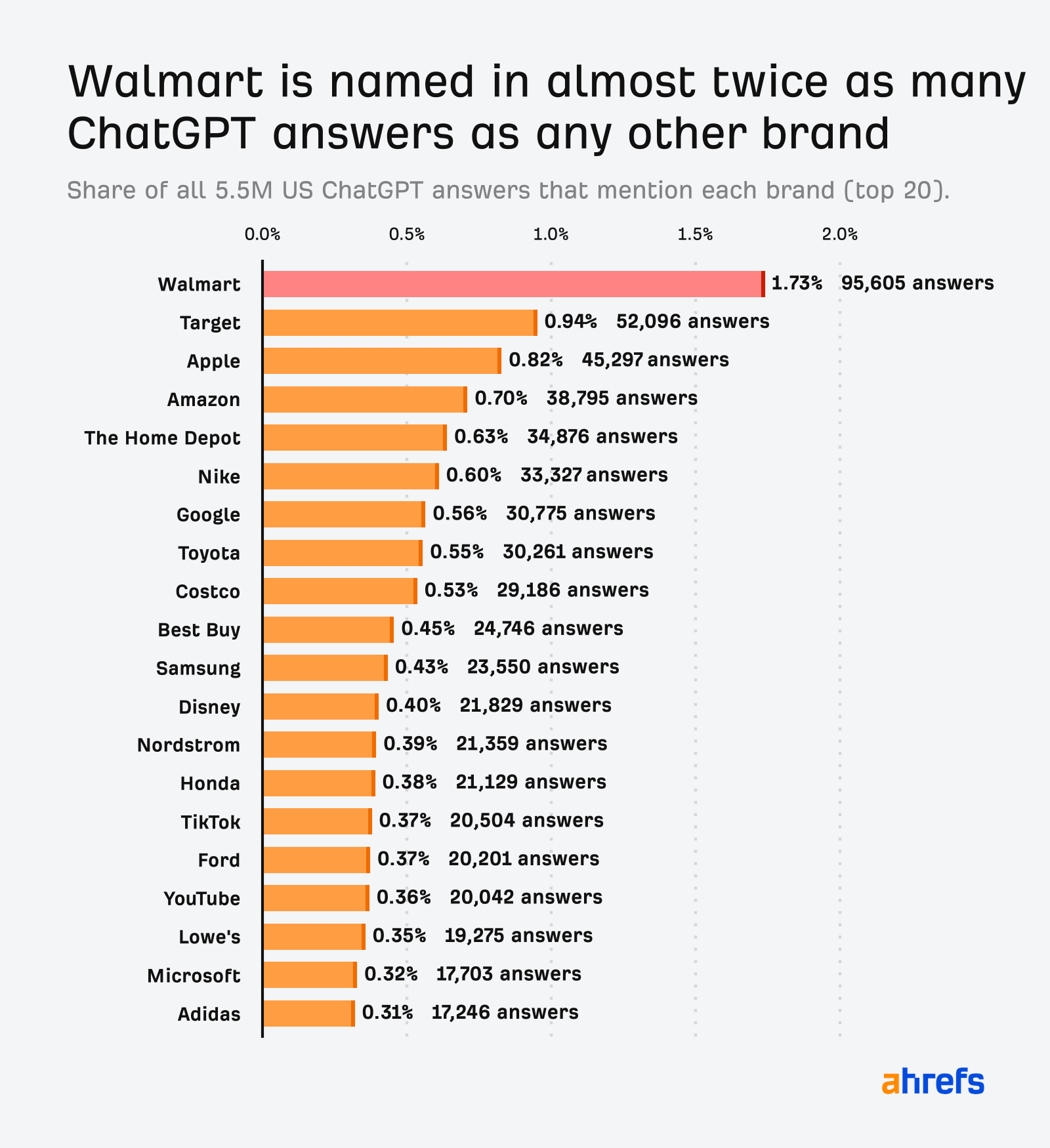
The 100 Most Mentioned Brands in ChatGPT (November 2026) · Ahrefs Blog
Walmart is named in 95,605 of 5.5 million sampled US ChatGPT answers, almost double Target, with stores taking six of the top ten spots and automakers claiming 15 of the top 100. Useful for benchmarking share of voice, but a mention isn't an endorsement, so before celebrating a high rank, check what ChatGPT is actually saying about you in those answers.
When SEO best practices become SEO dogma · Search Engine Land
A look at when SEO rules of thumb outlive the conditions that made them true. Worth a skim if your checklist hasn't changed in years even though the search results around you have.
Service
Only 4 of 68 public company chatbots answered three basic visitor questions · CustomerThink
An agent posed three basic questions, hours, billing updates, and product pricing, to 68 live company chatbots; only four answered all three on the first try, and the button-menu bots in the sample answered none of the questions fully. Run this exact test on your own chatbot this week; the recurring problem wasn't missing information, it was a bot that had the right answer and still didn't say it.
The customer insight you already have and have never used · CustomerThink
A researcher describes a department store retailer that ran 10 to 15 studies a year, all pointing to the same losses to a faster, better-reviewed competitor, and never changed course before the company folded. A cited 2026 Quantum Metric benchmark found 52% of 750 digital leaders have no formal process for acting on customer feedback and 24% have no owner for it, so before approving another study, write down the decision it's meant to produce.
People
Research: The Risks of Rewarding Top Employees with Better Schedules · Harvard Business Review
Harvard Business School researchers studied 1,189 restaurant workers to test whether handing top performers the best schedules carries a hidden cost for the company. Worth reading in full before you keep defaulting to that incentive with your own best people.
The Hidden Costs of Delegating to AI · Harvard Business Review
During the 2025-26 tax season, firms using automated tools for tax prep through the Current platform reportedly saved a third of practitioner time and raised throughput by about 50%, with one firm taking on roughly $300,000 of extra tax work late in the season. The piece is framed around hidden costs of delegating work this way, but the numbers shown here are all upside, so read the fuller case before assuming the costs outweigh the time saved.
Technology
Lovable apps expose passport details and more than 200K private messages · crissyfield.de
Researchers examined 159,041 projects built on the no-code app platform Lovable and found 34,545 using Supabase as their database; of 24,664 sites returning records without login, 7,403 (30%) exposed email addresses, including one forum leaking over 80,000 profiles and 200,000 chat messages, and one service provider exposing passport numbers for more than 1,000 people. If anyone on your team has shipped something on Lovable with Supabase, check row-level security this week, not after someone els
Transportation secretary blames ‘routine’ equipment upgrade for grounding flights nationwide · TechCrunch
A copper-to-fiber upgrade by contractor L3Harris overloaded a router and triggered only the third nationwide ground stop this century, canceling more than 8,200 flights Friday and another 3,000 Saturday; officials were explicit this was a hardware and network problem, not related to the air traffic controller tool rolled out a day earlier. The lesson for any ops leader: a 3pm Friday change at a 'remote' site still needs full change-control rigor, because remote doesn't mean low-risk.
Operations
Why Better Demand Forecast Accuracy May Not Reduce Inventory · All Things Supply Chain
Two forecasts can both score 90% accuracy while producing very different outcomes: in the piece's four-week example, a forecast that alternates between over- and under-predicting by ten units fills 95% of demand, while one that consistently underestimates by the same ten units fills only 90%, despite identical error scores. If your team reports forecast accuracy as a single percentage, start tracking the direction of the misses too; same-direction errors across a lead time erode service level in
Port of Los Angeles grapples with elevated rail dwell times · Supply Chain Dive
A dispatch on rising container rail dwell times at the Port of Los Angeles. Worth opening if you're routing West Coast import volume through rail right now.
One idea, distilled
Two stories this week point at the same blind spot from opposite ends. One tracks how often ChatGPT names a brand unprompted, Walmart turns up in nearly two percent of all US answers sampled, while the other finds that only four of 68 public company chatbots could answer three plain questions about hours, billing, and price on the first try. The shared assumption: that a conversational answer is automatically a useful one. Nobody has checked whether getting mentioned a lot by an outside chatbot means getting represented accurately, and few of the companies running their own chatbot seem to have checked whether it can do the one thing a human agent would do without hesitation, just answer the question. The forecast-accuracy piece makes the same point about inventory: a tidy number like 90% accuracy can describe two completely different real-world outcomes depending on the direction of the errors. The useful move this week isn't gathering more measurement, it's testing whether the measurement you already trust means what you assume it means. What would it take for your team to notice if your best metric was quietly lying to you? |
Sources (in order of appearance): Ahrefs Blog, Search Engine Land, CustomerThink, CustomerThink, Harvard Business Review, Harvard Business Review, crissyfield.de, TechCrunch, All Things Supply Chain, Supply Chain Dive